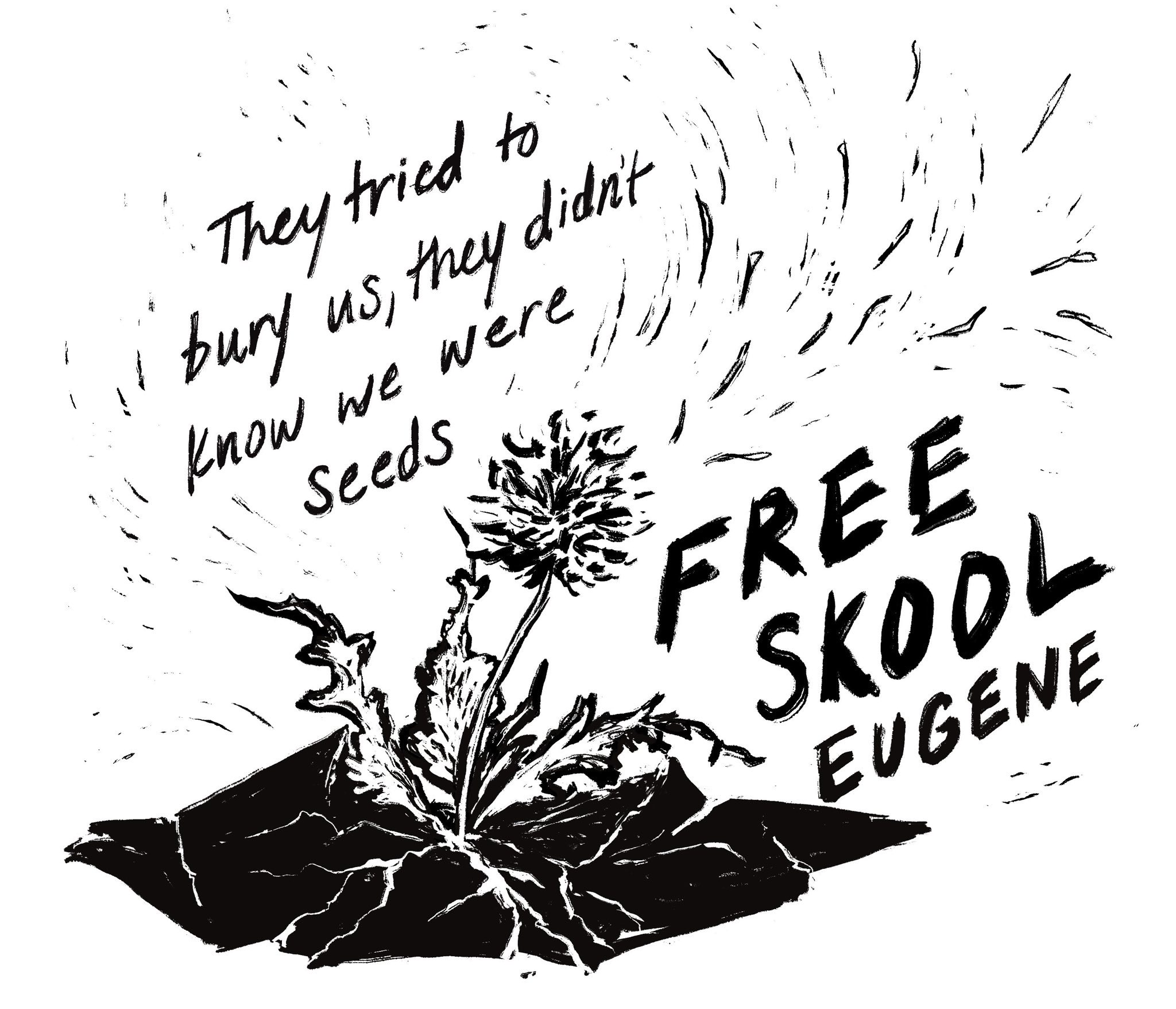


Free Skool Eugene is a collective that organizes spaces to share skills and knowledge, free of cost and state control. I sat down with organizers Jamie, Cyn, Janae, Emily, and Alex to chat about the project, their reflections after the first year, and their dreams for the future.
Free Skool is just what you might think it is from the name: education, free of charge.
In their own words: “Free Skool Eugene aims to provide an alternative, grass roots, and truly free approach to education based on the anarchist principles of anti-authoritarian, dissolution of hierarchy, mutual aid, access, and fostering community.” Functionally this looks like groups coming together to share what they know about any given skill or subject that someone in the community has experience with; it could be anything from sewing, navigation, salsa dancing, welding, plumbing, to Know Your Rights and Anti-fascism 101.
Free Skool Values
Flattening hierarchies: “Everyone is a teacher, everyone is a student. A kid could teach a class.” Jamie
Free, decentralized, and communal at its core, Free Skool breaks down not only the financial barriers of entry, but also the social. Identity and class lines, such as wealth, social status, or demographic, don’t divide who can access these educational spaces, and power is shared equally among participants. There is no inherent qualifier for a person to share or access knowledge, outside of their own lived experience.
Challenging Western conceptions of expertise: “You don’t have to be a master to share a skill.” Cyn
Along with the lack of financial barrier, what sets Free Skool apart from traditional academia is a move away from expertise derived only from institutional credentials. Those that share and teach at a Free Skool class draw not only from institutional learning, but from lived experience, and will often teach in pairs or groups to maximize and diversify the information. Additionally, a class or skill-share will often be held in an environment most fitting for the teaching. In order to learn drywall repair, the group convened in a home that required a patch in the wall. To learn a skill relating to growing food, they met at the Solidarity Garden.
Legacy and Oral History: “We preserve inter-generational knowledge through the legacy of sharing skills with each other.” Janae
Sharing skills and knowledge in low-barrier, inter-generational spaces keeps these skills from being lost, or deemed obsolete. The inception of the Free Skool project here in Eugene exemplifies this principle: Free Skools started in the 60s, following the long anarchist legacy of creating autonomous, accessible, non-hierarchical spaces for the people to gain tools of liberation. Skill-shares and workshops in temporary autonomous zones, as well as in fixed infrastructure such as community centers and infoshops, are one of the many ways that people have resisted authoritarianism for generations.
Alternative futures: “We’re laying the foundation for the future; that there can be regular, accessible skill-shares.” – Alex
Education is a political act. To make an alternative future, markedly, structurally, systemically different than the present and the recent past, we must widen the scope of what is possible. By deepening our knowledge of ourselves and the world around us, sharing skills and exchanging experiences in a non-hierarchical setting, we broaden our awareness of alternatives to the inequalities of a capitalist society. Through sharing our skills and knowledge with one another, the community becomes more resilient, and builds collective power that leads to liberation.
“Wielding the tool of education in non-hierarchical ways allows us to imagine alternative futures.” – Emily
Free Skool would love to have more participants. They are also looking to find more locations to host classes. If you’re interested in being a teacher please sign up! You can find them at freeskooleugene@gmail.com or on Instagram @eugenefreeskool.