


Unlike last month, I wasn’t able to put together a plain language forecast. I apologize for that, but please bear with me as I have tried to explain some of the more technical terms below.
• (ECMWF time-longitude Hovmöller)
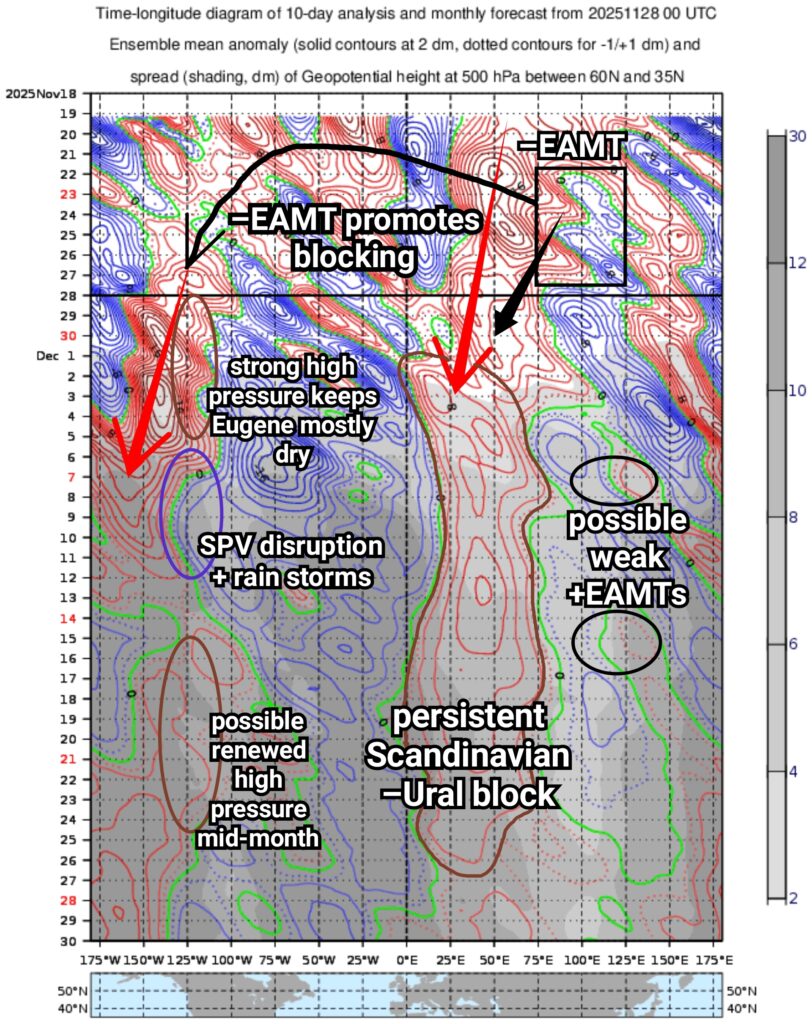
Strong Rossby wave flow is quickly giving way to a persistent blocking regime and Rossby wavebreaking.
Ural Basin high pressure regressing towards Scandinavia will induce a blocking regime and Rossby wavebreaking over North America.
So, over the next 4–5 weeks I would expect an alternating series of extended ridges and troughs. The current lengthy period of high pressure (ridging), for example, will get further extended, bringing us mostly dry weather for another four days.
• (CFSv2 Global Relative AAM)
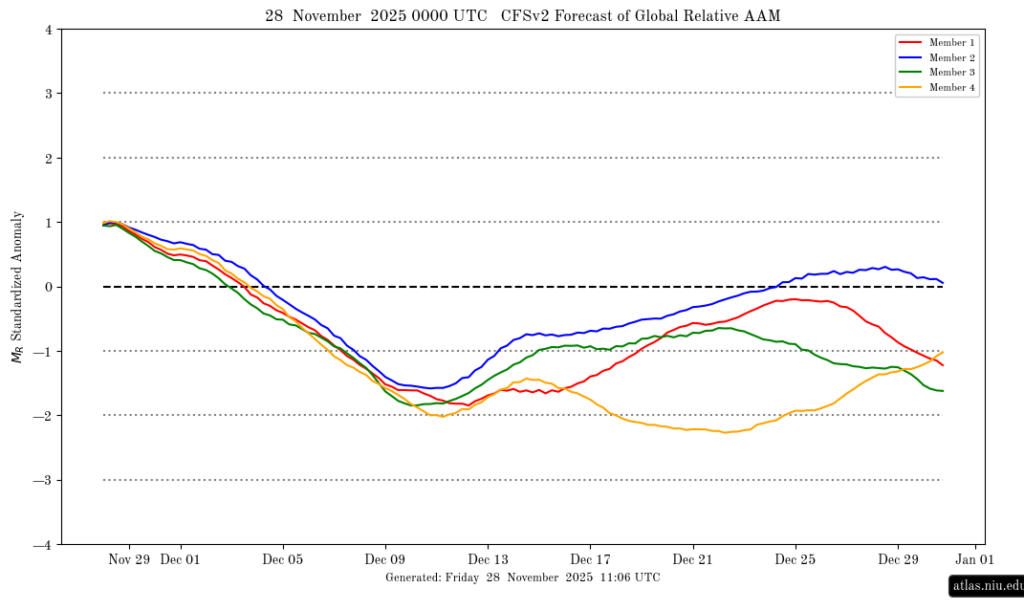
Atmospheric angular momentum (AAM, i.e. average global wind speeds) has reached a peak and is quickly declining. Meanwhile, eastward progression of the tropical Madden-Julian Oscillation (MJO) will slow down soon and bring us some much needed rainfall starting around Friday, December 5.
Negative east Asian mountain torque (–EAMT), lower AAM, and Rossby wavebreaking will all dovetail with the major stratospheric polar vortex (SPV) disruption currently underway to probably extend that period of rainfall for several days, with the coldest weather around Dec. 11–13.
POLAR VORTEX (SPV) FORECAST
• (GEFS mean polar cap heights)
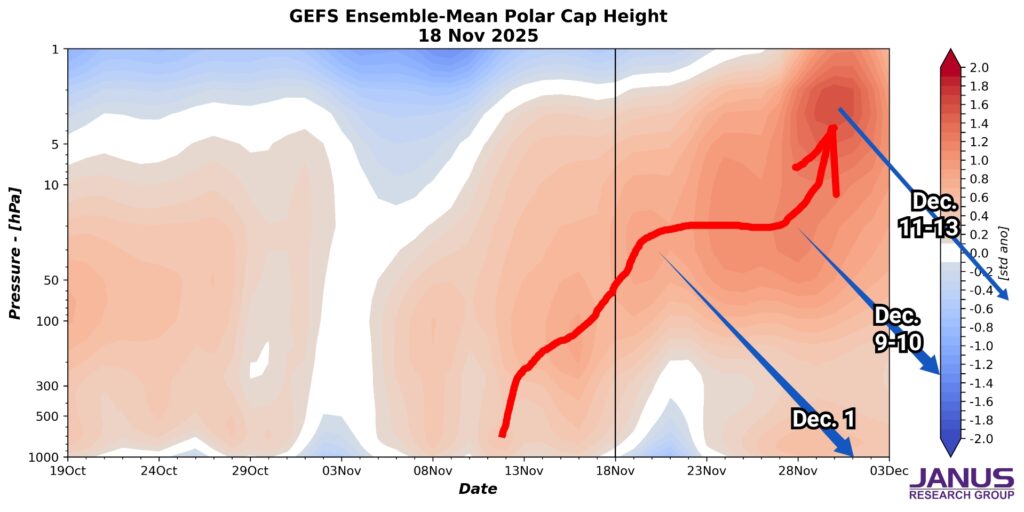
On Nov. 18, Dr. Judah Cohen (see link in the credits below) suggested that the long-awaited late November SPV disruption could involve a stretched polar vortex and “wave reflection” event. More recently he said he’s all in and this is exactly what is currently happening.
(A “wave reflection” occurs when a single wave or plume of high pressure gains enough altitude to take a big swipe at the lower SPV, but doesn’t quite have enough energy to cleanly split the vortex. This is called a “Wave-1” disruption, whereas a “Wave-2” pattern disrupts the SPV from both sides of the Arctic Basin.)
Something I noticed early on is the possibility of FOUR STAGES, so here I added some predictions for when the latter three disruption stages will affect Lane County.
NOTE that the 4th stage is currently underway and recently crossed the line into a “sudden stratospheric warming” (SSW) event in which the SPV stopped flowing east (clockwise from above) around the Arctic Circle and started flowing the other way.
Because this occurred for more than 24 hours straight, this event is considered a “major SSW“.
With La Niña reaching a peak in the last week and generally still promoting easterly equatorial trade winds, and with easterly QBO winds in the tropical stratosphere, the SPV will likely remain weaker than average for several weeks.
Thus, the prospect for a Wave-2 major SSW sometime in the next 3–6 weeks seems quite good.
• (10 hPa zonal winds)
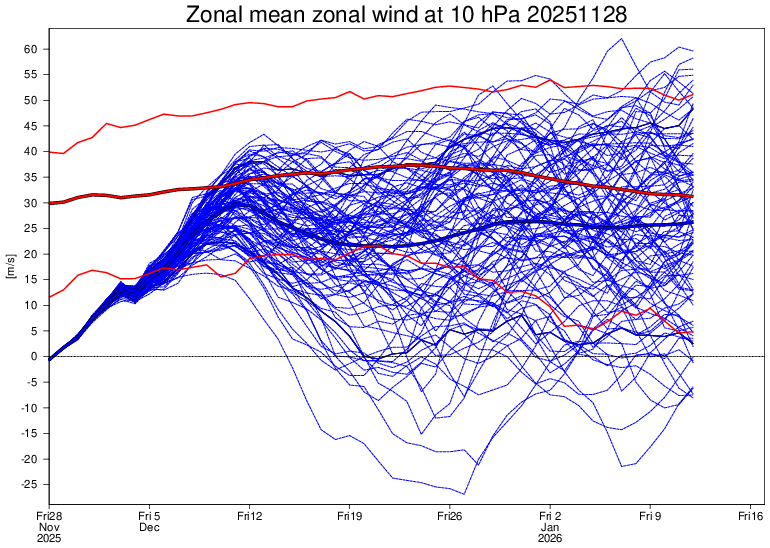
The 46-member ECMWF ensemble (EPS) mean prediction for SPV zonal wind speeds at 60° N. shows the next SPV disruption cycle getting initiated (briefly) around Dec. 4–5 at the lower levels.
But the main disruption has consistently shown up around Dec. 11–13 just as the SPV should be nearing its average strength for this time of year.
Peak disruption should occur roughly Dec. 14–16. And adding 13–14 days gets us to roughly Dec. 27–30. So, that’s about when I would expect significant winter impacts on the Northwest.
You can also faintly discern another SPV zonal wind downturn near the end of December.
As @Aigle_e tweeted several days ago, it is… “IMPORTANT to take a step back and not just look at your OWN country when making a long-term forecast.”
“Zooming out and looking further ahead, we see a strong Greenland–Scandinavia dipole, [which is] well-documented in the literature as a precursor to a major SSW.”
[That Greenland–Scandinavia dipole is very prominent near the center of the time-longitude Hovmöller diagram (first chart above).]
GRAPHICS CREDITS
• (chart #1) ECMWF (European Center for Medium-Range Forecasting
• (chart #2) Dr. Victor Gensini at Northern Illinois University
• (chart #3) Dr. Judah Cohen at Arctic Environmental Research, a subsidiary of JANUS Research Group (by permission)
And, here is the post Judah made on Nov. 20 predicting that the current SPV disruption would be a “wave reflection” event–
https://x.com/judah47/status/1991598893604434019
• (chart #4) ECMWF (European Center for Medium-Range Forecasting