


A new and destructive development project is rapidly moving through the city of Eugene’s permitting process: an Amazon fulfillment center. In all public communication surrounding permitting and construction, the facility’s owner is obscured, but the nature of the planned facility leaves little doubt that owner is Amazon. Residents fear that the construction of this giant warehouse would destroy wetlands, pollute the air, further entrench Eugene’s environmental inequities, and support the work of a corporation exploiting people and concentrating wealth here and across the world.
Plans for this distribution center have been submitted to the city of Eugene by BL Companies, an architecture and engineering firm based on the East coast that has a history of constructing Amazon facilities. Construction for this project is due to begin in December of this year, and is expected to be completed in January 2027. The proposed construction would cost $24 million dollars and result in a 320,000 square foot building and parking for around 1000 trucks and 400 worker vehicles.
Eighteen permits are required to begin construction, including permits from state agencies like the Oregon Department of State Lands, the Oregon Department of Environmental Quality (DEQ), and Lane Regional Air Production Agency (LRAPA). The majority of these permits are anticipated to be rubber-stamps, with Amazon easily being allowed to construct this facility.
Amazon already has 19 facilities in Oregon, including the largest in the Pacific Northwest. The facility, located in Woodburn, is a staggering 3.8 million square feet. Similarly to what’s underway in Eugene, the City of Woodburn welcomed the facility on the basis of economic growth. Amazon made millions of dollars of financial contributions to the city, including bus lines, road expansion, and even a million dollar soccer field. It appears this multi-trillion dollar corporation is able to bribe small towns and cities with promises of economic development, paving over farmland, forests, and wetlands with no consideration of the environment nor the people’s health and well-being.
The construction of an Amazon facility in Eugene would cause immediate environmental damage and ongoing pollution. The facility is sited on an 84 acre lot just west of Highway 99, 36 acres of which are government designated wetlands. Construction plans include filling and paving over at least 9 acres of these wetlands. According to the Eugene Weekly, the fulfillment center would result in an average of one vehicle trip every 28 seconds during the 20 hours of operation each day, totaling nearly 2,600 trips per day. This increase in vehicle traffic will emit harmful pollutants such as nitrous oxide and carbon monoxide. The increased air pollution would be concentrated in west Eugene, a neighborhood that already experiences the worst air pollution in the city. Statistics from Beyond Toxics reveal that annual pollution in west Eugene accounts for 96% of toxic emissions in Eugene. West Eugene is home to proportionately more low-income and BIPOC residents than the rest of the city, and the continued siting of polluting facilities in these neighborhoods is a blatant example of environmental racism.
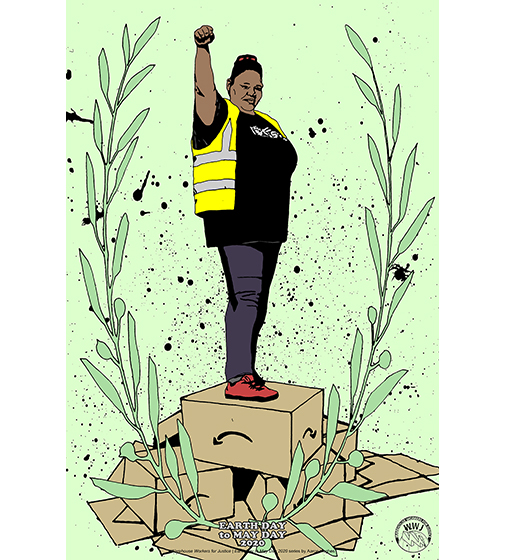
Amazon’s presence in Eugene would not only degrade the environment, it would also exploit the city’s workers. While decision makers have argued that this facility will help small businesses and boost the local economy through job growth, Amazon warehouse jobs are low-paying, fast-paced, dangerous warehouse positions with long hours and exceptionally high turnover. Worker testimonies reveal that Amazon pressures workers to work quickly, prioritizing speed over physical and mental health. Workers are highly surveilled and punished for taking bathroom breaks, to the point that some workers pee in bottles at their work station. Amazon uses a “point system” to discipline workers for working “slowly” or taking sick days. If a worker receives 6 points, they’re fired. One Amazon warehouse employee, James Bloodwort, compared their workplace to a “prison in a totalitarian state.”
Warehouse employees have been injured, and even killed, working in fulfillment centers. In December of 2021, an Amazon warehouse in Illinois collapsed after a tornado, killing 6 employees. Multiple lawsuits were brought against Amazon as a result, claiming Amazon was negligent in alerting employees of the risk even though the company knew the worker’s were in harm’s way, and that the building was poorly constructed. As these deadly working conditions reveal, corporate greed is at the forefront of Amazon’s motivation. Amazon has a CEO-to-worker pay ration of 43:1, increasing annually, and in 2024 alone, the CEO of Amazon made $40 million.
Despite the push-back that the construction of this facility has already met, public officials appear unable, or unwilling, to stop it. In the face of this inaction, there’s a need for more people to track the project and stand up against it. While there’s no clear road-map for how to stop a massive corporation like Amazon, an effective resistance will likely require a diversity of tactics. As the project moves through permitting, there may be intervention points within the legal process and opportunities to put pressure on public officials. Resistance must not stop there— research, creativity, and courage can keep up a fight against Amazon beyond the legal process, uneven as permitting is ongoing and especially if construction is permitted.